If you’ve searched “best ERP for jewellery industry in India,” chances are you’ve already outgrown spreadsheets and a basic billing tool — and you’re now comparing systems that all claim to do the same thing. The honest answer is: most general-purpose ERP software wasn’t built for jewellery at all. It doesn’t understand gross weight vs net weight, doesn’t handle daily metal rate fluctuations, and has no idea what a karigar account or a gold saving scheme is.
This guide walks through what actually separates a good jewellery ERP from a generic one, the features worth insisting on before you sign a contract, and where JSoft ERP fits into that picture.
Why Generic ERP Software Doesn’t Work for Jewellers
Accounting software and generic ERP systems are built around a simple model: item, quantity, price. Jewellery doesn’t work that way. A single piece of jewellery carries gross weight, net weight, stone weight, purity, making charges, wastage percentage, and a metal rate that can change more than once in a day. Try forcing that into a standard ERP and you end up with workarounds in Excel that live outside your actual system — which is exactly where errors and mismatched stock counts creep in.
A true Jewellery ERP software is built around weight and purity as core data fields from day one, not bolted on as an afterthought. That difference alone is usually what separates “Software We Tolerate” from “Software That Actually Saves Time.”
10 Must-Have Features When Choosing the Best Jewellery ERP in India
Whichever software you shortlist, these are the features worth checking off before you commit:
1. Real-time metal rate management Gold, silver, and platinum rates move daily — sometimes more than once. Your billing should pull live rates automatically, not rely on someone updating a rate card by hand every morning.
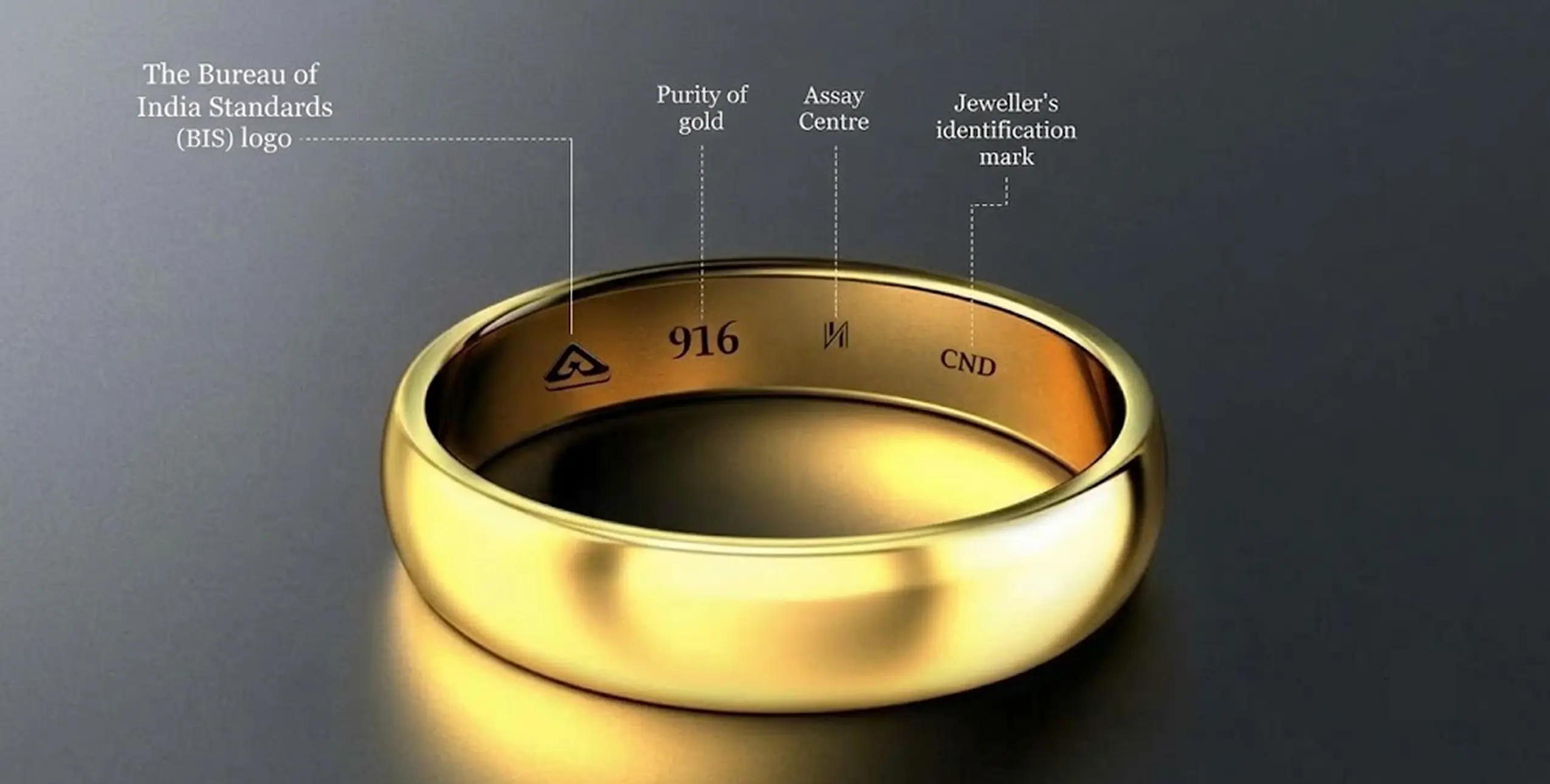
2. Weight and purity tracking Gross weight, net weight, stone weight, and purity (hallmark/BIS) need to be core fields on every item, not custom workarounds.
3. Making charges & wastage calculation Look for automatic making-charge and wastage calculation rules that match how your business actually prices – percentage-based, per-gram, or fixed – with built-in checks to catch entry errors before billing.
4. Karigar / job-work management If you work with karigars for repairing, hallmark issue/receipt, or custom orders, your ERP needs a dedicated module to track metal issued, metal received back, and wastage – not a manual register.
5. Old metal exchange management Old gold and silver exchange is routine in Indian jewellery retail. The system should handle purchase, refinery tracking, and resale with full transparency, not a separate spreadsheet.
6. GST-compliant billing Non-negotiable in 2026. Your ERP should generate accurate, GST-compliant invoices and keep you audit-ready without manual reconciliation.
7. Scheme / gold saving scheme management If you run monthly installment schemes or bookings for customers, look for a system that tracks scheme ledgers, redemption, and maturity automatically – this is a major customer loyalty driver in Indian jewellery retail and a common gap in generic software.
8. Multi-branch / chain store support If you run more than one showroom – or plan to – you need real-time, branch-wise stock and sales visibility from one place, not end-of-day manual consolidation.
9. RFID and inventory accuracy For high-value inventory, RFID integration adds a real layer of stock accuracy and theft/shrinkage detection that barcode-only systems can’t match.
10. Cloud access, mobile apps & WhatsApp integration Being able to check reports, approve orders, or reply to a customer on WhatsApp without being physically at the store isn’t a “nice to have” anymore – it’s expected.
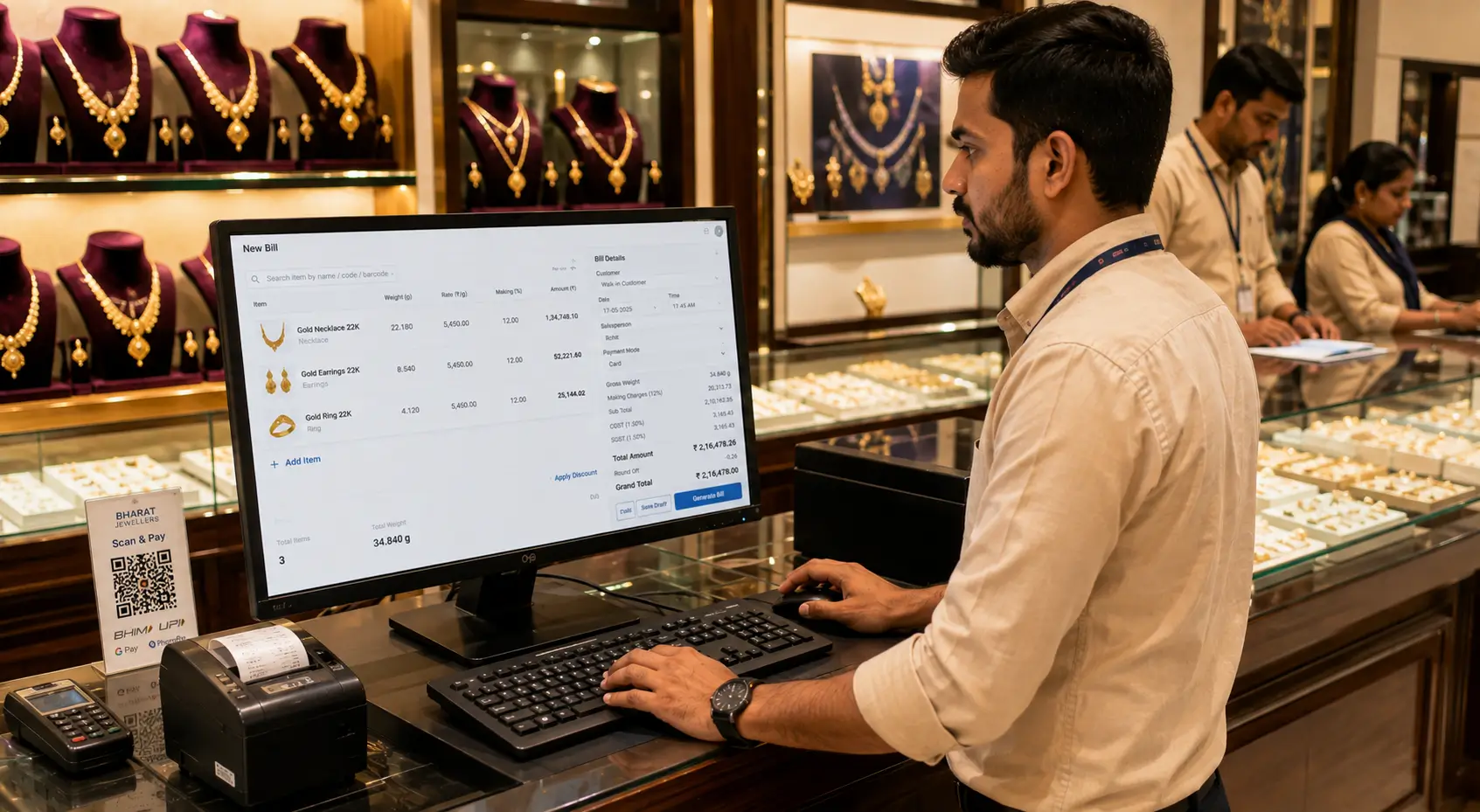
Think about the last time a customer asked “what’s today’s rate for this design?” and someone had to manually check and calculate on the spot. Or the last stock audit where a piece’s recorded weight didn’t match what was actually in the tray. These are exactly the gaps a jewellery-specific ERP is built to close.
Cloud vs Desktop: What Should You Actually Choose?
This comes up in almost every ERP conversation, and the honest answer is: it depends on how you operate.
- Choose cloud if you run multiple branches, want real-time visibility from anywhere, or need staff to access billing/reports on mobile.
- Choose desktop/on-premise if you have a single location with a stable local setup and prefer to keep everything on local infrastructure.
Either way, make sure your data — stock, billing, and customer records – stays synchronized and backed up, not siloed by branch.
Questions Worth Asking Before You Buy
- Does the vendor understand jewellery-specific workflows, or are they adapting a generic retail ERP?
- Can the system scale from a single store to multi-branch without a full re-implementation?
- Is pricing transparent, or will you discover module-by-module add-on costs later?
- What does onboarding and ongoing support actually look like – and how fast do they respond when something breaks during business hours?
- Can you see it running on a live jewellery business before you commit, not just a sales demo script?
Why JSoft ERP Is Built for the Indian Jewellery Trade
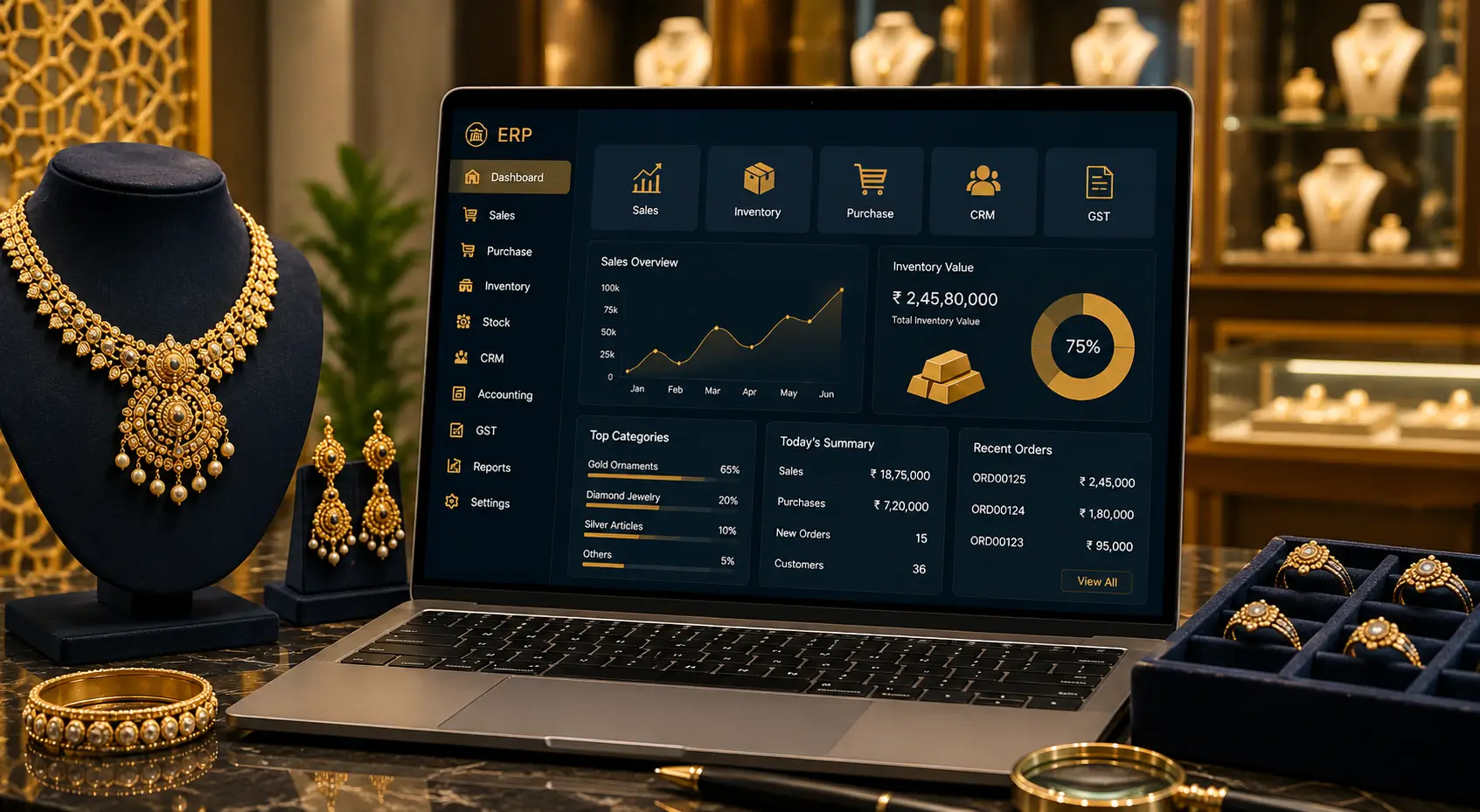
JSoft ERP, built by Alpha ERP Solutions – with 25+ years of experience serving 5,000+ clients across India – was designed specifically around the checklist above, not adapted from a generic retail template:
1. Scheme Management – gold saving schemes and bookings with full ledger and redemption tracking
2. Karigar Management – hallmark issue/receipt, repairing, and custom order tracking against metal issued
3. Old Metal Management – complete purchase, refinery, and resale tracking for gold and silver exchange
4. GST-compliant billing – built in from the ground up, not added as a patch
5. Diamond, casting & manufacturing management – lot, size, quality, and shape-wise diamond stock tracking; karigar-wise labour costing for manufacturers and wholesalers
6. Multi-branch / chain store management – with real-time, store-wise stock and sales visibility
7. RFID integration – for high-value inventory accuracy
8. Mobile apps and Meta-verified WhatsApp Business (Alpha Chatbox) – for billing, reports, and customer communication on the go
9. JewelDeal – a dedicated B2B & B2C app extending your catalogue beyond the showroom
10. AI-powered tools – including AI-generated catalogue photography and virtual try-on – that plug straight into your existing inventory and billing data
Because these modules are purpose-built for gold, silver, diamond, and antique jewellery businesses – retail, wholesale, and manufacturing – there’s no retrofitting a generic system to understand your business. It already does.
The Bottom Line
The “best” ERP for your jewellery business isn’t necessarily the one with the longest feature list – it’s the one built around how jewellery actually works: weight, purity, metal rates, karigar accounts, and schemes, backed by GST compliance and real support when you need it. If you’re evaluating options, use the 10-point checklist above with every vendor you shortlist – including JSoft ERP.
FAQs
Q1 Is jewellery ERP software suitable for small jewellery shops, or only large chains?
Yes. Modern cloud-based jewellery ERP systems are modular, so small single – store jewellers can start with core billing and inventory and add manufacturing, scheme management, or multi-branch features as they grow.
Q2 Does JSoft ERP support multiple branches and warehouses?
Yes. JSoft ERP supports multi-location inventory tracking, letting retailers, wholesalers, and manufacturers manage stock across branches and warehouses from one system.
Q3 Is JSoft ERP GST compliant?
Yes. JSoft ERP includes built-in GST billing and compliance tools, helping jewellers generate accurate, audit-ready invoices under Indian tax regulations.
Q4 What does a karigar management module actually do?
A karigar (goldsmith) management module tracks the metal you issue to karigars for repairing, hallmark, or custom orders, and reconciles what comes back – including wastage – so nothing is tracked manually or lost between registers.
Q5 How much does jewellery ERP software cost in India?
The cost of jewellery ERP software in India depends on the number of users, branches, and modules required – ranging from affordable single-store plans to enterprise pricing for multi-branch manufacturers and wholesalers. Most vendors, including JSoft ERP, provide a customized quote after understanding your business scale.
Ready to see a jewellery ERP built around how your business actually works? Book a free JSoft ERP demo today.